
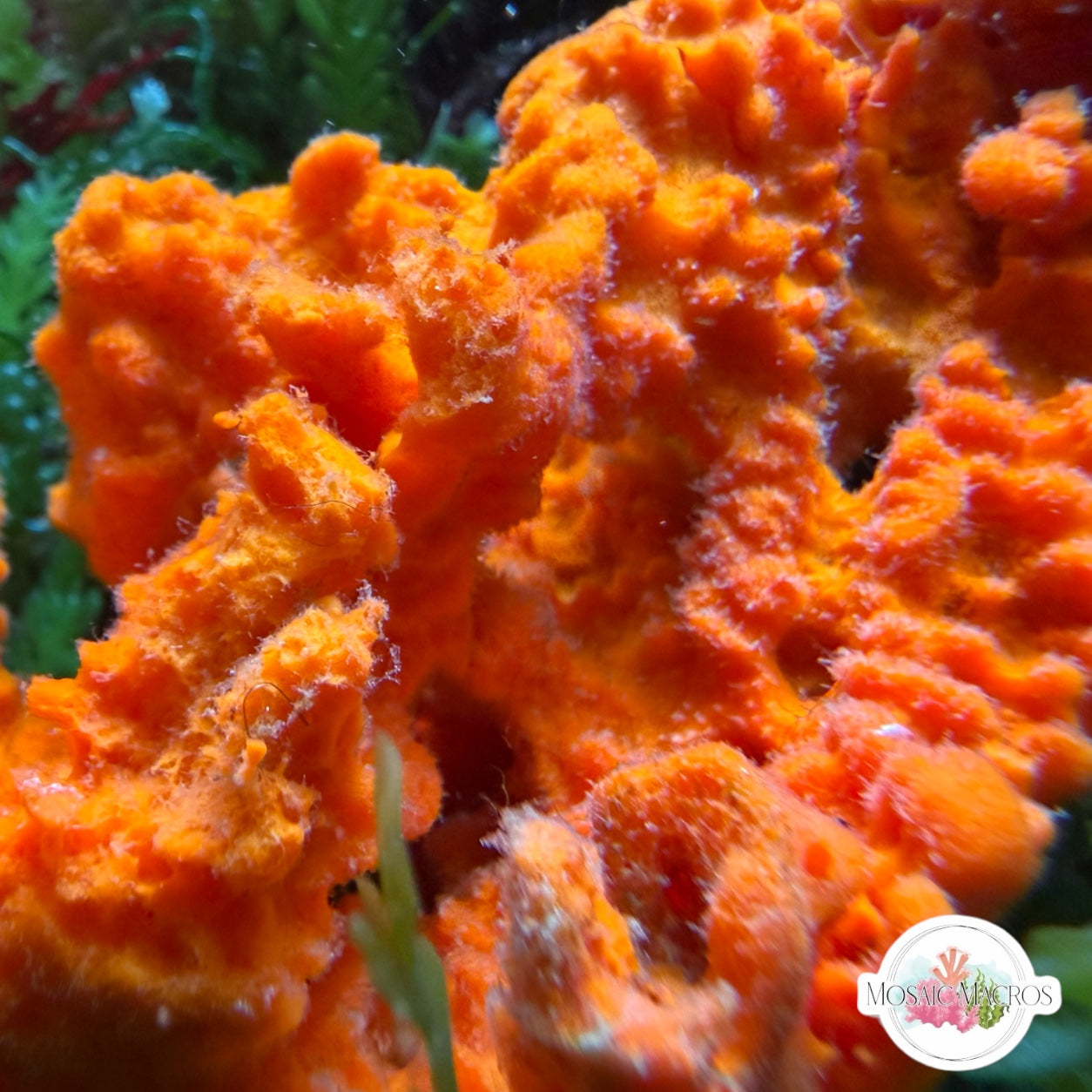
Textured Orange Sponge | Unknown sp.
Textured Orange Sponge | Unknown sp.
SHIPPING RESTRICTION: THIS ITEM MUST BE SHIPPED VIA FEDEX PRIORITY OVERNIGHT SHIPPING!
Disclaimer: Due to variations in this species, your specimen may not be identical to the representative photo.
The Textured Orange Sponge is a beautiful ornamental marine sponge recognized for its vibrant orange coloration, intricate surface texture, and distinctive natural growth formations. Individual specimens display brilliant shades of tangerine, golden orange, coral, and deep reddish-orange, creating a striking contrast against live rock, colorful corals, and other ornamental marine organisms. Its exterior features a textured surface composed of small ridges, pores, and irregular projections that give the sponge an intricate, sculptural appearance. Depending on its growth pattern, colonies form rounded cushions, irregular lobes, or spreading encrusting formations that conform naturally to surrounding rockwork. Like other marine sponges, this organism belongs to the phylum Porifera, a group of primitive multicellular animals that obtain nutrition by filtering microscopic particles and dissolved organic materials from seawater. Rather than possessing conventional organs or a digestive system, sponges utilize specialized cells and an intricate network of internal canals to circulate water throughout their bodies. Their unusual anatomy, brilliant coloration, and fascinating filtration abilities make them exceptional additions to established marine aquariums.
Care Level: Difficult
Temperament: Peaceful
Reef Safe: Yes
Diet: Filter Feeder / Bacterioplankton, Picoplankton, and Dissolved Organic Matter
Temperature: 74–80°F
Specific Gravity: 1.024–1.026
pH: 8.1–8.4
The Textured Orange Sponge is best maintained in mature, established marine aquariums with stable water parameters, consistent water circulation, and a reliable supply of suspended microscopic food particles. Unlike photosynthetic corals and macroalgae, marine sponges do not rely on light as their primary energy source. Instead, they obtain nutrition by continuously filtering seawater through specialized internal channels, capturing bacteria, microscopic plankton, and other suspended organic materials.
One of the most important considerations when maintaining ornamental marine sponges is providing sufficient natural food availability. Established reef aquariums with diverse microbial populations, live rock, and active biological filtration provide a more suitable environment than newly established or excessively sterile systems. Supplemental additions of appropriately sized phytoplankton, bacterioplankton, and specialized sponge foods can help support nutritional requirements. However, feeding must be carefully balanced to prevent excessive nutrient accumulation and deterioration of water quality.
Consistent, indirect water circulation is essential for healthy sponge function. Water movement helps replenish suspended food particles, maintain oxygen availability, and remove metabolic waste from the surrounding environment. Stagnant conditions encourage the accumulation of detritus and interfere with efficient filtration, while excessively concentrated currents can damage delicate tissues. Positioning the sponge in an area with steady, dispersed circulation supports natural feeding activity and long-term health.
Marine sponges should remain completely submerged during handling, acclimation, and placement. Exposure to air can introduce bubbles into their internal canal systems, interfering with normal water circulation and filtration. Specimens should be transferred underwater whenever possible and handled gently to avoid crushing their porous tissues. Once positioned within the aquarium, unnecessary movement and repeated handling should be minimized.
The Textured Orange Sponge is generally compatible with peaceful reef fish, shrimp, snails, and other ornamental marine invertebrates. However, certain angelfish, butterflyfish, nudibranchs, and specialized sponge-feeding organisms can damage or consume its tissues. Persistent grazing should be prevented to preserve the sponge’s structural integrity and overall health.
Although marine sponges lack the aggressive stinging tentacles associated with many corals, direct contact with neighboring organisms should be avoided. Some sponges produce biologically active compounds that discourage predators or influence nearby organisms. Providing adequate spacing from sensitive corals helps minimize physical interference and competition for available surfaces.
Maintaining stable salinity, temperature, pH, and overall water chemistry is essential for successful long-term care. Sudden environmental fluctuations, prolonged food shortages, excessive sediment accumulation, and exposure to unsuitable conditions can cause tissue deterioration. Healthy specimens retain their characteristic coloration, firm structure, and intact surface texture, while progressive discoloration, tissue breakdown, or a strong decaying odor indicates serious deterioration.
The sponge’s textured exterior contains numerous microscopic openings through which seawater enters its internal filtration system. Specialized flagellated cells generate water currents that transport suspended nutrients throughout the organism. Filtered water is subsequently expelled through larger openings known as oscula. This continuous circulation allows the sponge to process substantial quantities of seawater while contributing to nutrient cycling within the aquarium ecosystem.
Regular observation is important for identifying changes in coloration, tissue integrity, and overall appearance. Accumulated sediment should be prevented through appropriate aquarium circulation rather than aggressive brushing or direct physical cleaning. Stable environmental conditions and consistent access to microscopic food sources are particularly important for maintaining ornamental sponges over extended periods.
Its brilliant orange coloration, intricate textured surface, unusual biological structure, and fascinating filter-feeding behavior make the Textured Orange Sponge an exceptional addition to mature reef aquariums, specialized sponge gardens, cryptic marine displays, and naturalistic underwater ecosystems.
Couldn't load pickup availability
-
Free Shipping!
Free FedEx 2Day is available on orders of $200+ post-discounts, with a $25 upgrade option to Priority Overnight.
Free FedEx Priority Overnight is available on orders of $300+ post-discounts.